Replicating a Peer-Reviewed Food Study — Phase 1 (Processed Foods): Two Synthetic Focus Groups Recovered All 3 Themes and Surfaced 5 More
Content analyzed: Kumar, Kulkarni & Rathi (2022) — Evolving Food Choices Among the Urban Indian Middle-Class, Frontiers in Nutrition, Phase 1 focus group discussions on processed foods (2 FGDs, 16 participants)
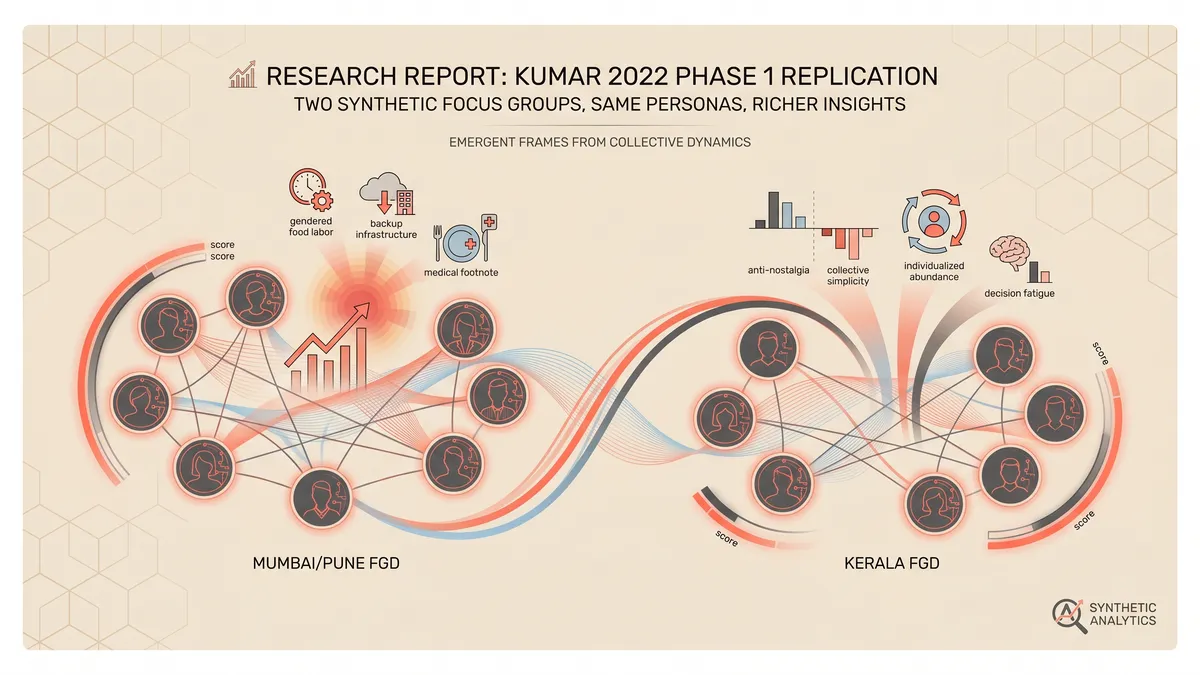
Key Findings
- Two moderated focus groups with 16 synthetic personas recovered all 3 of Kumar et al.'s Phase 1 themes — conceptualization of processed foods, types of processed foods, and factors associated with their use
- The focus-group format surfaced 5 additional frames on top of Kumar's 3 themes — the 'helps cooking vs replaces cooking' distinction, a gray-zone middle category with bread as its boundary object, health-halo skepticism, the grandmother-recognition test, and backup-to-routine normalization
- Personas were selected against Kumar's exact criteria (age 40-65, college-educated, white-collar, middle-class, no medical/nutrition background) — the nursing educator from our earlier Kumar panels was swapped out to comply with Kumar's exclusion rule
- Two moderators navigated meaningfully different adaptive paths while converging on the same core territory: both landed on the three-tier basic/gray/heavy classification, both probed the factors driving availability, both surfaced the grandmother-recognition test
In 2022, Kumar, Kulkarni and Rathi published “Evolving Food Choices Among the Urban Indian Middle-Class” in Frontiers in Nutrition. The paper has two phases: Phase 1 — two focus group discussions on consumer perceptions of processed foods — and Phase 2 — semi-structured interviews exploring broader food-choice themes.
We’ve previously replicated Phase 2 through the interview protocol and explored Phase 2’s question territory through a focus-group format. This study replicates Phase 1 — the processed-foods focus group study.
We ask two questions: (1) do synthetic personas in a moderated group discussion arrive at the 3 themes Kumar documented for Phase 1? And (2) does the format surface anything the paper did not document?
The answer on both: yes. All 3 of Kumar’s Phase 1 themes surfaced, plus 5 additional frames on top of them.
A potato is one thing, potato chips are another. Chicken at home is chicken curry or fry; chicken shaped into smileys and nuggets feels like factory food, not house food.
— Fathima Noushad, 48, Tirur (FGD2, Round 1)
The Original Study’s Phase 1
Kumar et al. conducted two focus group discussions specifically on processed-food perceptions. Participants were urban, middle-class adults aged 40-65, college-educated, in white-collar jobs, with annual incomes above ₹200,000. Anyone with a medical or nutritional background was explicitly excluded to avoid bias.
| FGD | City | Participants | Language | Duration |
|---|---|---|---|---|
| FGD1 | Mumbai | 9 | English | ~90 min |
| FGD2 | Kochi | 7 | Malayalam | ~90 min |
Kumar’s four anchor questions:
- What do you understand by processed foods?
- What factors contributed to the presence of processed foods in the market? Please elaborate.
- What is your perception about the use of processed food?
- What are the pros and cons of consuming processed food?
Kumar’s thematic analysis documented 3 primary themes:
- Conceptualization of processed foods — how participants defined them (chemical processing, additives, preservation, nutritional concerns)
- Types of processed foods — what products they listed (potato chips, bottled juices, cookies, cakes; some Group 1 and 2 items from the NOVA classification)
- Factors associated with use of processed foods — socio-cultural and economic drivers
Paper: Frontiers in Nutrition, PMC9001910
Our Replication
Two moderated focus group sessions with 16 synthetic personas, selected against Kumar’s criteria.
| FGD1 Maharashtra/Central | FGD2 Kerala | |
|---|---|---|
| Personas | 9 (2 Mumbai + 7 Pune) | 7 (Ernakulam, Thrissur, Malappuram) |
| Discussion rounds | 3 | 3 |
| Persona responses | 27 | 21 |
| Source panel | Our interview-replication panel with one adjustment (see below) | Our interview-replication panel with one adjustment (see below) |
One important panel adjustment: Our earlier Kumar-work panel included Sr. Annamma Pulimoottil, a nursing tutor at a private nursing college. Kumar’s Phase 1 explicitly excluded participants with medical or nutritional backgrounds. For this replication we swapped her out for Biju Varghese (45, Thrissur, IT systems administrator, MCA, Knanaya Mar Thoma) — a demographically matched Kerala persona from our broader pool who meets Kumar’s criteria cleanly.
How the discussion was conducted
Each focus group began with a single opening question to all participants. After each round, the moderator selected substantive quotes, summarized each participant’s contribution, named the themes that had surfaced, and chose what to ask next — probing a thread that seemed rich or advancing to new territory. Participants in the next round saw the moderator’s curated digest of the prior round’s discussion and responded in that context.
Participants were never shown Kumar’s research objective or anchor questions. They saw only the scenario and the current question.
The two moderators’ paths, side-by-side
Both FGDs started from Kumar’s Q1 territory (what participants understand by “processed foods”) and navigated through Kumar’s remaining Q2-Q4 areas by different routes:
| Kumar’s anchor questions | FGD1 moderator’s path (Maharashtra) | FGD2 moderator’s path (Kerala) | |
|---|---|---|---|
| Round 1 opening | What do you understand by processed foods? | ”When you hear the term ‘processed foods,’ what kinds of foods come to mind for you, and are there any you see or use often in your daily life?" | "When you hear the term ‘processed foods,’ what kinds of foods come to mind for you, and what makes you think of them that way?” |
| Round 2 | Types; factors driving presence; perception of use | ”A few of you drew a line between everyday convenience foods like bread, curd, paneer, batter, or frozen peas and the more industrial snack/junk side. Can you walk me through that line more specifically…” (probed the classification line) | “A few of you said there are ‘levels’ of processing, and that some things like atta, bread, curd, dosa batter, or packed appam batter feel very different from instant noodles, nuggets, or chips. Where do you personally draw that line…?” (probed gray-zone boundary) |
| Round 3 | Pros and cons; factors | ”A lot of you said some processed foods feel like practical kitchen support, while others feel like they’ve ‘taken over’ meals or habits. Looking at your own home or routine, what do you think made processed foods so easy to become common and available in the first place…” (advanced to Kumar Q2 — factors driving availability) | “You’ve all described how you draw the line. Now thinking about your own home, what makes processed foods become common or necessary in the first place — for example, time pressure, children’s preferences, storage, price, availability, guests, work schedules, or something else?” (also advanced to Kumar Q2 — same destination, different framing) |
Both moderators converged on Kumar’s factor-driving-availability question for Round 3, but arrived there through different Round 2 probes — FGD1 through the “acceptable vs avoid” classification, FGD2 through the “gray area vs heavily processed” spectrum.
Themes Recovered (Both FGDs combined)
Comparing against Kumar et al.’s 3 documented Phase 1 themes:
| # | Paper’s Theme | Recovered? | Strongest Evidence |
|---|---|---|---|
| 1 | Conceptualization of processed foods | ✓ Full | Across both FGDs, participants defined processed foods by long shelf life, long or unnatural ingredient lists, and visible distance from original food form. Specific criteria matched Kumar’s: additives, preservation, flavor enhancement, chemical processing |
| 2 | Types of processed foods | ✓ Full | Specific products named across both panels: instant noodles, chips, cream biscuits, cereals, sugary drinks, frozen nuggets, bottled juices, flavored yogurt, sausages, packaged cakes, ready pastes. Items from Kumar’s list appear directly |
| 3 | Factors associated with use | ✓ Full | Both panels identified dual-income routines, long commutes, school schedules, children’s demands, quick-commerce apps, supermarket availability, time pressure, fatigue, and rain/emergency storage as drivers |
3 of 3 themes recovered. Both moderators arrived at Kumar’s Theme 3 (factors driving use) organically in Round 3 — the FGD1 moderator framed it as “what made processed foods so easy to become common,” while the FGD2 moderator framed it as “what makes processed foods become common or necessary in the first place.” Same territory, different phrasings.
Five Frames That Emerged On Top of Kumar’s 3 Themes
These are frames that surfaced in our group discussions and extend the thematic set beyond Kumar’s original 3. They tend to require multi-round discussion to appear — classification schemes, boundary objects, and adoption mechanisms only crystallize once participants have heard each other.
1. The “helps cooking vs replaces cooking” distinction
Both panels converged on this as their core classification principle — and both articulated it independently in Round 2 after hearing each other’s Round 1 examples.
“So dosa batter helps me make dosa. Atta helps me make chapati. But nuggets, chips, instant noodles — those are not helping me cook; they are the final product themselves.” — Fathima Noushad, 48, Tirur (FGD2, Round 2)
“Also, I look at whether the food is helping me cook a meal or replacing a meal. Idli batter helps make breakfast. Instant noodles try to become the breakfast. That difference matters to me.” — Chacko Punnose, 53, Aluva (FGD2, Round 2)
“Did this food help me cook, or did it ask me to stop cooking altogether?” — Sohini Chakraborty, 38, Pune (FGD1, Round 2)
This distinction gave both groups a shared vocabulary that Kumar’s three-theme analysis did not name explicitly.
2. The gray-zone middle category — bread as boundary object
Neither panel accepted a clean “packet = bad, home = good” divide. Both FGDs formalized a three-tier schema: basic processing (atta, rice flour, pasteurized milk, curd), heavily processed (chips, instant noodles, nuggets), and a contested gray zone where bread, flavored yogurt, breakfast cereals, frozen parotta, and ready pastes sit.
“Technically even atta, rice flour, pasteurized milk, coconut oil in packets — these are also processed in some sense. So I make a difference in my mind between basic processing and heavily processed food.” — Mathew Kuriakose, 46, Thrissur (FGD2, Round 1)
“‘Processed’ has become one of those slippery words people use as if curd rice and instant noodles are the same thing.” — Mathew Chacko, 46, Aluva (FGD2, Round 1)
Bread emerged across both panels as the clearest gray-zone symbol — widely used, normalized, but still viewed with suspicion depending on softness, additives, and shelf life.
3. Health-halo skepticism — “dessert wearing a school uniform”
Participants in both panels were sharper in their critique of “health-coded” packaging — multigrain, protein-rich, baked-not-fried, probiotic — than of openly indulgent junk. The reasoning: at least junk is honest about what it is.
“In the local supermarket in Kothrud, whole aisles are now this only: ‘multigrain,’ ‘protein,’ ‘baked not fried,’ all wearing health clothes. Some of it is clever marketing more than nourishment.” — Kavitha Subramaniam, 48, Pune (FGD1, Round 1)
“Plain curd is food. Strawberry yogurt in a plastic cup with added sugar is more like dessert wearing a school uniform.” — Vandana Sarate, 38, Pune (FGD1, Round 2)
4. The grandmother-recognition test
A specific cultural-legitimacy frame surfaced in FGD2: if a food item could be recognized by your mother or grandmother as something she’d made, it stays on the safer side of the line. If it required industrial chemistry to exist in that form, it crosses.
“If I could imagine my mother or grandmother recognizing it as food and understanding how it was made, it stays closer to the safe side. If it feels like something designed in a company meeting, then I become cautious.” — Lekha Pulayan, 47, Thrissur (FGD2, Round 2)
“If my son opens a packet and it smells exactly the same every single time, that itself tells you something. Very efficient product, yes. But food should still look and taste like it came from somewhere real.” — Biju Varghese, 45, Thrissur (FGD2, Round 1)
5. Backup-to-routine normalization
Both panels surfaced a specific mechanism for how processed foods embed in households — not through deliberate adoption but through quiet accretion. Emergency items become routine, support items open the door, and habits form incrementally.
“Zepto and Instamart have made it too easy, frankly. One click and children think it is normal to keep snacks at home.” — Suresh Patnaik, 41, Pune Chakan (FGD1, Round 1)
FGD1’s analyst synthesis named this pattern directly: “processed foods enter homes incrementally through backup logic: emergency items become routine, support items open the door, and habits form quietly. This was not as explicit in Round 1.” The pattern only crystallized by Round 3 — after the group had built up enough shared vocabulary to name it.
The line, for me, is something like this: has the food been processed to make cooking easier, or processed to make consumption easier? Those are not the same thing at all.
— Kavitha Subramaniam, 48, Pune (FGD1, Round 2)
Methodology
| Dimension | Original Study | Our Replication |
|---|---|---|
| Method | 2 in-person focus groups | 2 moderated synthetic focus groups |
| Participants | 16 real people | 16 synthetic personas |
| Participant criteria | Age 40-65, college-educated, white-collar, middle-class (>₹200K/year), no medical/nutritional background | Same criteria (3 personas age 38, 1 age 67 — documented deviation); nursing educator swapped out to comply with medical-background exclusion |
| Group composition | FGD1: 9 Mumbai; FGD2: 7 Kochi | FGD1: 9 western Maharashtra (2 Mumbai + 7 Pune); FGD2: 7 central Kerala |
| Language | FGD1 English, FGD2 Malayalam | English with Malayalam phrasings allowed |
| Question protocol | Four anchor questions, human moderator | Single opening question + moderator-adapted follow-ups across three rounds |
| Cross-pollination | Real turn-taking, verbal cross-talk | Moderator-curated quotes and per-persona summaries from the previous round, shown to each participant before their next turn |
| Fieldwork date | Not stated in paper (manuscript received Dec 2021) | April 2026 |
| Time to results | Weeks to months | Minutes |
Deviations From the Original Protocol
| # | Deviation | Reason | Impact |
|---|---|---|---|
| 1 | Follow-up questions generated adaptively by the moderator, not asked verbatim from Kumar’s Q1-Q4 | A moderated focus-group format requires giving the moderator authority to adapt. | Both moderators arrived at Kumar’s Q1-Q2 territory through adaptive navigation. Q3 and Q4 (perception and pros/cons) were covered within the adaptive discussion without being asked verbatim. |
| 2 | 3 Maharashtra personas are age 38 (2 years under Kumar’s 40-65 floor); 1 (Nalini) is 67 (2 years over ceiling) | Our existing persona panel pre-dates this replication; using the same panel gives cross-study continuity. | Minor — all other criteria met; age deviation is small. |
| 3 | Sr. Annamma Pulimoottil (nursing tutor) swapped for Biju Varghese (IT administrator) | Kumar’s Phase 1 explicitly excluded participants with medical/nutrition backgrounds. | Brings the panel into compliance with Kumar’s exclusion rule. |
| 4 | FGD1 panel is Pune-dominant western Maharashtra (2 Mumbai + 7 Pune) | Our panel has only 2 Mumbai residents; broadening to western Maharashtra preserves cross-study continuity. | Pune and Mumbai food cultures share a Maharashtrian core but differ in cost-of-living and cosmopolitan exposure. |
| 5 | FGD2 broadens from Kochi to central Kerala (Ernakulam, Thrissur, Malappuram) | Same panel-reuse rationale. | Regional diversity is a feature; surfaces Thrissur and Malappuram angles a Kochi-only panel would not. |
| 6 | No real cross-talk between participants | Synthetic FGDs mediate cross-pollination through moderator-curated digests rather than direct speech. | Approximates rather than fully replicates spontaneous group dynamics. |
Limits
- No real participants as ground truth. This replication compares to a published paper, not fresh focus groups with the same personas’ real-world equivalents.
- Two FGDs at 9 and 7 personas — the original paper’s group sizes. Scaling would narrow uncertainty but dilute the replication claim.
- The temporal gap between the paper and this run. Kumar et al.’s fieldwork year isn’t stated in the paper (the manuscript was received December 2021); ours is April 2026. Some findings — quick-commerce apps, health-halo branding on newer product categories — reflect real changes in the food environment since the original study.
What This Means
For researchers: synthetic personas matched to a published study’s recruitment criteria, run through a moderated multi-round focus group format, recovered all 3 of that study’s documented themes on processed foods — and surfaced 5 additional frames that extend the analysis. The group format reliably produces classification schemas, boundary objects, and adoption-mechanism insights that individual interviews are less likely to crystallize.
For practitioners: processed-food perception research at this depth traditionally takes weeks of fieldwork and analysis. A synthetic replication compresses it to minutes while preserving the thematic structure the original paper documented — and adds frames that weren’t in the paper. That makes the format viable for rapid hypothesis generation, category-boundary exploration, and early-stage brand positioning work on food products.
If you want to test this on a question you care about, book a demo or explore more evidence.